
Introduction
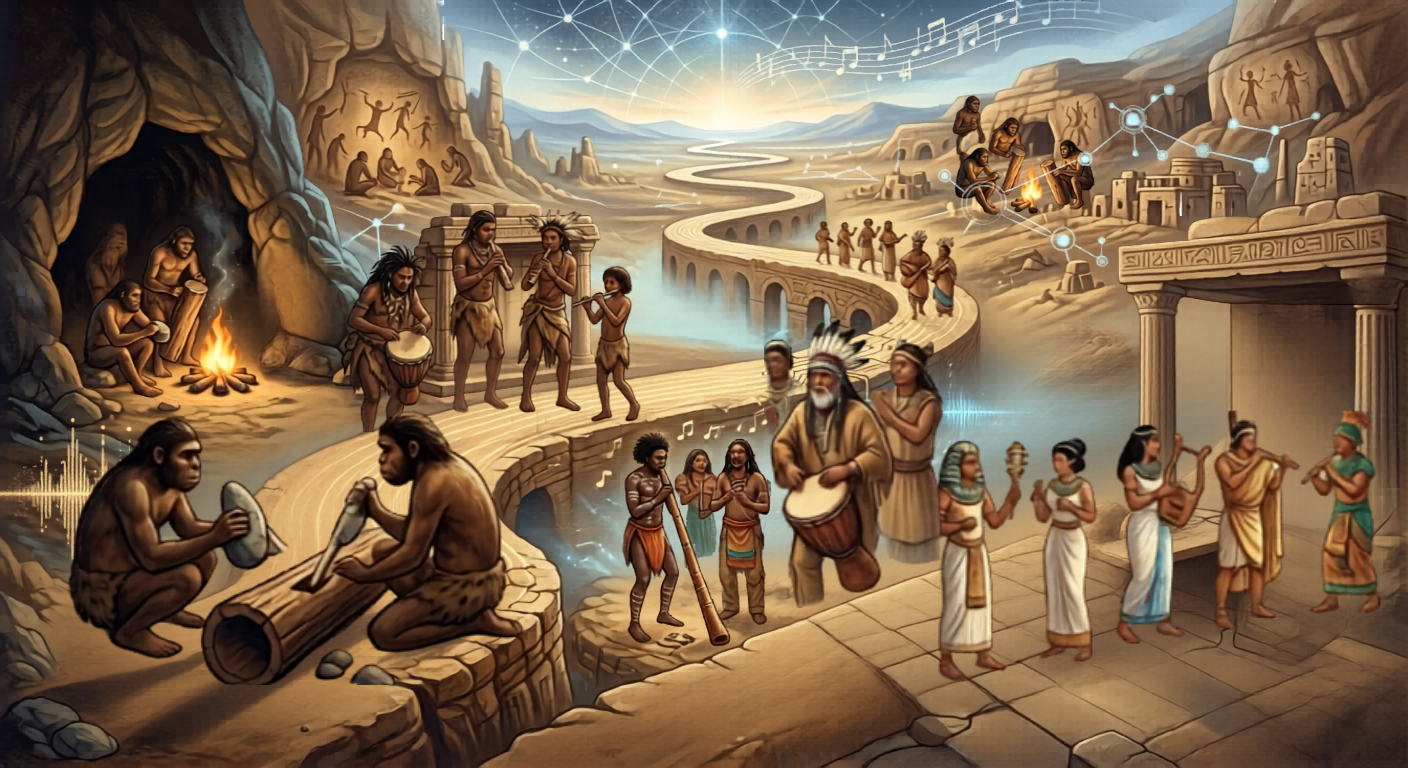
Long before the invention of writing, musical notation, or modern recording technology, humanity was bound together by sound. From the rhythmic beating of primitive drums around prehistoric fires to the complex digital soundscapes of the modern era, music has always been intertwined with human existence. But why did our ancestors start making music? How did sound help shape our species?
To answer these questions, we look through the lens of musical anthropology (Ethnomusicology)—the fascinating study of how music functions within human cultures, social structures, and our evolutionary history.
1. Music as an Evolutionary Tool for Survival
From an anthropological perspective, music is not just a form of entertainment; it is an evolutionary survival mechanism.
-
Social Bonding: Early human tribes used synchronized rhythm and group singing to foster community trust. In a world full of physical threats, a tribe that sang together and bonded together was more likely to survive.
-
The Precursor to Language: Many anthropologists believe that a form of “musilanguage” existed before formal spoken languages developed. Pitch, rhythm, and tone were used to convey emotions, signal danger, and express empathy.
2. Rituals, Myths, and Cultural Identity
Every culture across the globe has developed its own distinct musical identity. Anthropology explores how music serves as the ultimate vessel for preserving history and cultural rituals.
-
Sacred Rituals: In ancient civilizations and indigenous tribes, music was the bridge to the spiritual world. Shamanic drumming, chants, and folk songs were integral to healing rituals, harvests, and rites of passage.
-
Oral Traditions: Before books, history was sung. Anthropologists study folk music to decode historical events, migration patterns, and the belief systems of ancient societies that were passed down through generations.
3. The Biology of Anthropology: Music and the Human Body
Anthropology also intersects with biology (Bioanthropology) when we look at how human anatomy evolved to support music.
-
The Vocal Apparatus: The evolutionary lowering of the human larynx allowed for a wider range of vocalization, enabling humans to sing complex melodies.
-
Neurological Hardwiring: Human brains are uniquely hardwired for rhythm. When we hear a beat, our motor cortex lights up, causing us to move instinctively. This shared biological response is a universal human trait, transcending borders and languages.
4. Why Musical Anthropology Matters Today
In our fast-paced, tech-driven world, understanding the anthropological roots of music helps us stay connected to our core humanity. It proves that music is not a luxury product of modern civilization, but a fundamental pillar of human nature. By studying how ancient cultures used sound, modern fields like Music Therapy can innovate new ways to heal minds and reduce stress using primitive, time-tested acoustic principles.
Conclusion
Music is the soundtrack of human evolution. It is a living archive of where we have been, who we are, and where we are heading. As we continue to innovate with sound technology, looking back at our anthropological roots reminds us that at the heart of every digital wave is an ancient human pulse.
Type your paragraph here